

The Garber Era, Pt. 1: Survival and Stability
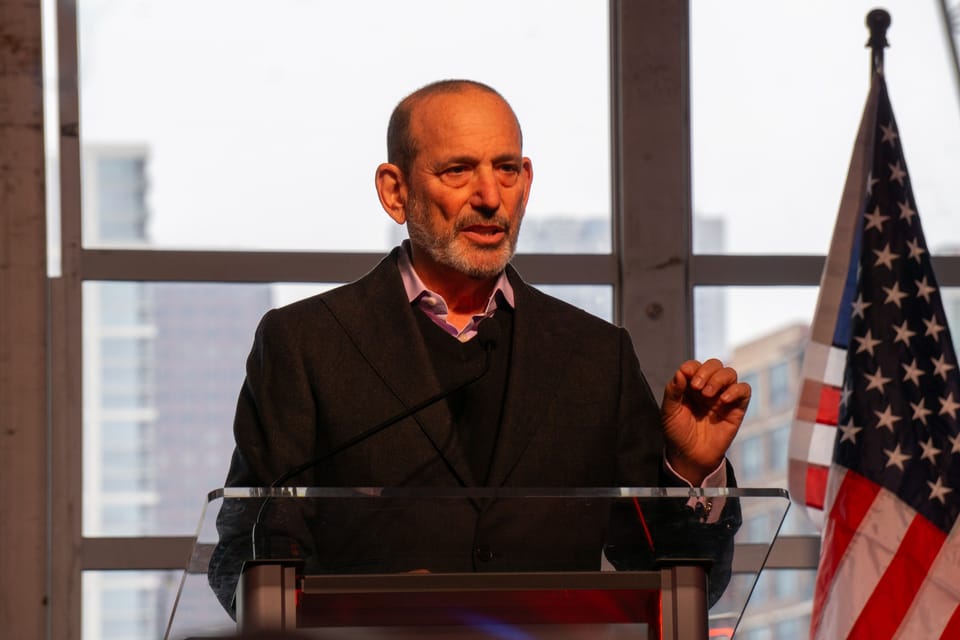
Let's get this out of the way: Fans will always hate the commish. In every league in every sport.
Roger Goodell is regularly booed at the NFL draft. When NHL fans are at their happiest – seeing their team win the Stanley Cup – Gary Bettman is booed presenting the trophy. Bob Manfried has been called "the worst thing to happen to baseball since the Black Sox scandal." Adam Silver's honeymoon that he got only by virtue of not being David Stern is rapidly ending.
It's all part and parcel of the role. The commissioner's job is to protect sports team owners – who, as a group, are 1) very rich and 2) largely not the best decision-makers (they own a pro sports team!) and 3) highly competitive (again: they own a pro sports team!) from criticism and their worse impulses. It's to make sure that their desire for competition doesn't result in wasteful spending. The job is, often, to be a human meat shield: Protect owners from fans, protect owners from themselves, both singularly and collectively.
Don Garber is not immune from any of this. Even outside of the circles of fanatics who seem to think that everything associated with the most-watched, best-attended, and most successful top flight soccer league in the United States' (and Canada's) is pure, unadulterated evil, Don Garber is not popular.
But he has still been one of, if not the best commissioners in the history of modern professional sports, in any league, by virtually any objective measure.
Garber helped save the league
When Garber became MLS commissioner in 1999, virtually every metric of a league's success – attendance, revenue, TV ratings – was pointed down.
For a growth strategy, the league had hitched itself to the success of the US Men's National Team. In the 1994 World Cup, which led directly to MLS's creation, the USMNT made it out of the group stage.
USMNT players were seen as the marketable stars for the nascent league. MLS's labyrinth of roster rules and restrictions all have their lineage from the Allocation Order, which was originally designed to give a pecking order to MLS teams for USMNT players.
The league hoped that a good tournament from the USMNT in France '98 would serve as a springboard for more interest in the sport domestically. The USMNT flamed out, and it didn't happen.
Even the league's successes became told the story of a league that wasn't doing well: A USA Today article covering the opening of Crew Stadium, marking the first time that a top-flight league had a purpose-built facility in the modern history of the sport in this country, noted "the 22,500 seat facility has no roof to hold the noise or keep fans dry," quoting a fan who was given a tour of the facility saying it had a "proletariat, factory look."
A graphic in the same article gave the information first game at only physical monument to the nascent league's existence: "May 15 7:30 p.m. Crew vs New England Revolution. TV: ESPN2 (tape delay at 11 p.m.)"
If soccer fans around the country wanted to see the new stadium's first game, they'd have to stay up late. (Let's call that foreshadowing, but that's for Part 2)
Just two years later, the league almost (or may have actually) folded, with the league had lost a reported $250 million in its first 5 years – impressive, considering the salary cap for each of the 10 teams in the league hovered around $1.2m at the time.
Garber helped engineer a salvation, but needed Lamar Hunt to do it. The league contracted, with the Miami Fusion – the Fire's 1998 expansion sibling – and the Tampa Bay Mutiny contracting.
Don Garber kept the ship from sinking.
Then stabilized it
For the first five half decade or so, it wasn't clear that it would be more than a temporary salvation.
Despite the experience in 1998, the league still felt that the USMNT was the ticket to growth. Garber convinced the owners to form Soccer United Marketing (SUM) in 1998, purchasing the media rights to the 2006 and 2006 World Cup tournaments.
That more directly connected MLS owners to US Soccer's commercial success, but even a much-improved USMNT performance in the 2002 World Cup, with the team reaching the quarterfinals (... and almost farther) didn't translate into significantly improved interest in the MLS's product. In 2004, the partnership deepened, with SUM effectively becoming SUM's commercial arm.
That gave MLS owners even better access to the financial upside of the national teams, but became controversial as a result: The interests of the domestic top flight and the federation aren't unrelated in any country, but in the US, they were intimately comingled.
It became clear that while connections to US Soccer might help MLS's growth, it wouldn't be a sole catalyst.
In 2005, the league resumed expanding, adding Real Salt Lake and Chivas USA, a second team in LA. Salt Lake pushed MLS into secondary markets – the population of the Salt Lake metro area at the time was about 1.2 million, and at the time, the league lacked teams in far larger cities.
Chivas USA was a direct attempt to find an alternate, non-US Soccer-affiliated path to growth. It also represented the most direct bet by a Mexican club to that point in the commercial potential of soccer in the United States, a fascination that ultimately helped lead to the creation of the Leagues Cup.
The expansion fees were small. Chivas USA would both practice and play out of the LA Galaxy's facility, significantly reducing the outlay needed to start and operate the new club.
Salt Lake and Chivas USA represented different bets about the future of the league. The league was now experimenting with formulas for growth, but clearly hadn't found one yet.
Despite the expansion, the league wasn't past troubles: The San Jose Earthquakes, who had rebranded just five years previously and could never find a stable home stadium, relocated to Texas and became the Houston Dynamo.
While Houston was a major market, a massive misstep by ownership – alienating much of the large and soccer-passionate Mexican-American community in the city by initially naming the team after an Alamo reference – instantly blunted the team's commercial potential.
The league was surviving, and trying to find a way to, if not thrive, grow, but it had yet to do it.
